
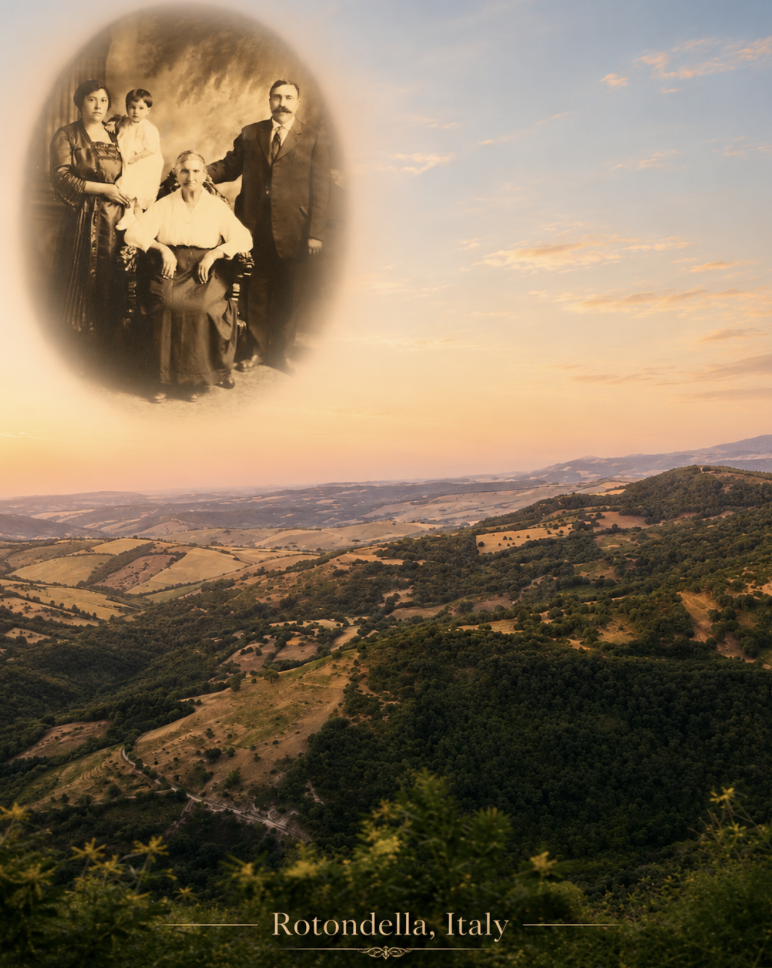
 “The contours of the story will be familiar to many,” Alexandra Lawrence wrote in The Florentine about LIFETIME. “A young woman, Carmela, leaves her poor village in southern Italy at the turn of the century to join her husband in America… The first generation refuses the culture of their parents, while the second embrace it, even returning to the homeland to pay homage and connect to their familial roots.”
For me, that journey began with my grandmother, Carmela, my north star and harbor in difficult times. Carmela and my mother, Laura, never got along, nor did my mother and I. Yet both were extraordinary grandmothers. I’ve often wondered why love sometimes seems to skip a generation.
As a child, I questioned my nonna endlessly about Rotondella, but she rarely spoke of her past. “They are no good stories. Go away with these ideas.”
Years later, when my life went off the rails, I traveled alone to Rotondella. I needed to touch the ground, smell the smells, and taste the foods she had cooked for me. There, I found family and began to understand not only Carmela but also Laura, a young woman desperate to be American and free of the constraints of her parents’ world. I began to see how Rotondella had shaped all three of us.
As Alexandra concludes, “The real drama, however, lies not in what happened, but in how the truth brings us to a place of love and forgiveness able to cross time and space—able to hold pain but also to be the antidote and the healing cure.”
Can the land of our ancestors heal us? I don’t know if it can for everyone, but Rotondella changed the way I understood my grandmother, my mother, and ultimately myself.
Leave A Comment